Most drivers glance at their MOT certificate, confirm it says “pass,” and put it in the glovebox. But the document contains far more useful information than just the outcome — and if your car has failed, knowing exactly how to read the VT30 is essential before you decide what to do next.
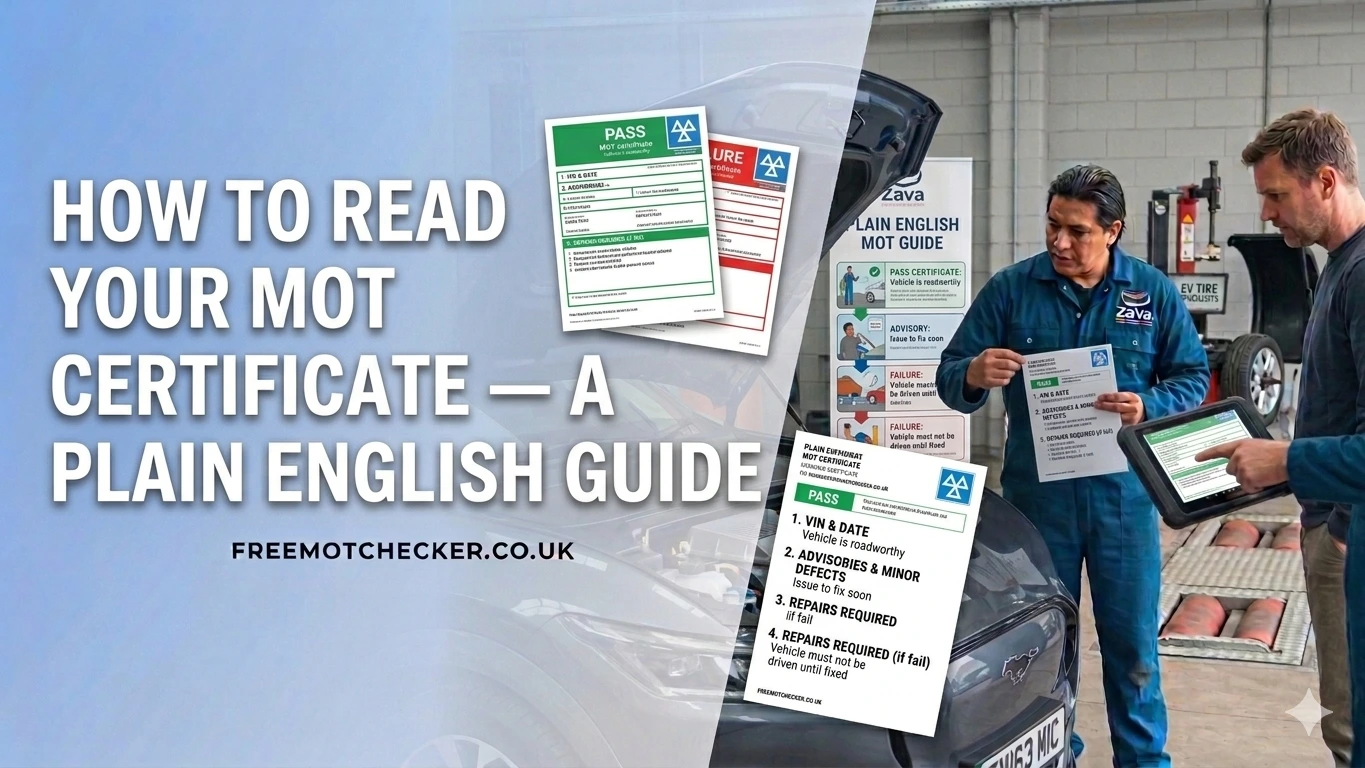
This guide walks through every section of both MOT documents — the pass certificate (VT20) and the failure notice (VT30) — in plain English, field by field.
The Two MOT Documents — VT20 and VT30
Every MOT produces one of two official documents:
VT20 — MOT Test Certificate (pass) Issued when your vehicle meets all DVSA safety and emissions standards. This is proof your car is legally roadworthy. It is valid for 12 months from the test date.
VT30 — Refusal of MOT Test Certificate (fail) Issued when your vehicle has one or more dangerous or major defects that prevent it from passing. This is not just bad news — it is a legal document and a detailed repair checklist. Keep it safe.
There is also a third document you may see:
VT32 — Advisory Notice Sometimes issued separately alongside a VT20 when the tester has noted items of concern that did not cause a failure but should be monitored. In most cases, advisories are printed directly on the VT20 rather than as a separate VT32.
Since 2012, all three documents are printed in a simple receipt-style format. The official record is held digitally in the DVSA database — the paper copy is a printout of that record, not the record itself. This means you can always retrieve your MOT information online using your registration number, even if you lose the physical certificate.
How to Read a VT20 — MOT Pass Certificate
Section 1 — Vehicle details
The top portion of the VT20 confirms the identity of the vehicle that was tested. Check these fields carefully whenever you receive a new certificate.
Registration number (VRM) Your vehicle’s number plate. Confirm this matches your car exactly — a digit transposed here means the record may not be attributed to your vehicle correctly in the DVSA database.
Vehicle Identification Number (VIN) A unique 17-character code assigned by the manufacturer. It is stamped onto the chassis and printed on your V5C logbook. The VIN on the certificate should match the VIN on your vehicle — if they differ, contact the test station immediately.
Make and model The manufacturer name and vehicle model as held in the DVSA system. Minor formatting variations are common (e.g. “VOLKSWAGEN” rather than “VW”) but the make and model should clearly identify your car.
Colour As registered with the DVLA. This is the colour recorded on your V5C, not necessarily the colour the car is painted if it has been resprayed.
Odometer reading The mileage recorded by the tester at the moment of the test. This figure is logged permanently in the DVSA database and is one of the most useful tools for detecting odometer tampering (clocking) in used cars. Every mileage reading across the vehicle’s full test history is visible when you run a check.
You can view the complete mileage history for any vehicle — across all previous MOTs — using our free MOT history checker. Inconsistencies between recorded mileages are one of the clearest red flags when buying a used car.
Section 2 — Test details
Test date The date the MOT was physically carried out. This is the date from which the 12-month validity period runs.
Certificate expiry date The date your MOT expires — exactly 12 months after the test date. Your car must have a new valid MOT certificate before or on this date to remain legal. Note: if you booked your test early while the previous certificate was still valid, the new expiry date is calculated from 12 months after the previous certificate’s expiry date — not the test date — ensuring you do not lose any time. See our guide on is the MOT first test changing from 3 to 4 years? for more on MOT timing rules.
Test station number A unique DVSA-assigned code identifying the authorised test centre that carried out the test. This links the test permanently to a specific garage in the DVSA system.
Tester number Identifies the individual MOT tester who conducted the inspection. This is logged in the DVSA database and is relevant if you ever need to query or appeal the result.
Test number A unique reference number for this specific test. You will need this if you request a duplicate certificate from the garage or if you submit an appeal.
Section 3 — Advisories and minor defects
Below the test details, the VT20 lists any items the tester noted that did not cause a failure but should be monitored or addressed.
Advisory notes Items the tester observed that are within legal limits today but approaching the threshold where they may not be at the next test. Advisories are not legally binding — your car has passed — but they are the single strongest predictor of what will fail next time. For a full explanation of what each type of advisory means and how urgently to act on it, see our guide: What do MOT advisory notes mean — and do you have to fix them?
Minor defects Formally classified DVSA defects that did not cause a failure because they are not yet significant enough to compromise safety. These are more formally defined than advisories and carry a specific DVSA defect code. Like advisories, they do not restrict your driving but should be addressed before the next test.
Section 4 — What the VT20 does NOT guarantee
The certificate includes a printed statement that is easy to overlook: your MOT is a snapshot of the vehicle’s condition on the day of the test. It is not a guarantee of mechanical condition for the following 12 months, and it does not cover components not included in the MOT inspection — such as the engine internals, clutch, or gearbox. A car can pass its MOT in the morning and develop a mechanical fault in the afternoon. This is why regular servicing alongside MOT testing is important.
How to Read a VT30 — MOT Failure Notice
The VT30 is more detailed than the VT20 because it must explain exactly why the vehicle failed. Read every section carefully — it is your repair roadmap.
Section 1 — Vehicle and test details
The top of the VT30 contains the same vehicle identification fields as the VT20: registration number, VIN, make, model, colour, mileage, test date, station number, and tester number. Check these for accuracy exactly as you would on the VT20.
Section 2 — Defect listings
This is the critical section. The VT30 lists every defect found during the test, grouped under clearly labelled headings. Each group is separated by a thick line to make the categories visually distinct.
“Do not drive until repaired” — Dangerous defects If this heading appears on your VT30, accompanied by a warning symbol, your vehicle has one or more dangerous defects. This is the most serious outcome. You must not drive the vehicle on a public road — the law is unambiguous here, regardless of whether your previous certificate is still valid.
Each dangerous defect listed beneath this heading includes a description of the fault and the specific component or system affected. For a full explanation of what dangerous defects mean and what your options are, see our guide: What is a dangerous MOT defect — and what happens next?
“Repair immediately” — Major defects Major defects cause the vehicle to fail the MOT. Whether you can drive away depends on whether your previous certificate is still valid and whether the car remains technically roadworthy. Each major defect is described with the fault type and the component involved.
For the precise rules on driving after a major defect failure, see: What is a major MOT defect — and can you drive home after failing?
“Monitor and repair if necessary” — Minor defects Minor defects appear on the VT30 as part of the test record even though they do not cause the failure. They are still worth noting — particularly if they overlap with advisory notes from previous tests, which could indicate a pattern of neglect on a specific component.
Advisory notes on a VT30 Even when a car fails, the tester still notes advisory items separately. These are items that are within legal limits but worth monitoring. Do not ignore advisories on a VT30 simply because the car has also failed — they represent future risk independent of the current failure.
Section 3 — Tester’s signature
The VT30 is signed by the tester who conducted the inspection. This signature, alongside the tester number, links the test formally to a qualified, DVSA-registered individual. This detail matters if you appeal the result.
Section 4 — Appeal information
The reverse of the VT30 explains your right to appeal. You have 14 working days from the test date to submit an appeal using form VT17 on GOV.UK. Crucially, you must not carry out any repairs to the failed items before the appeal is assessed — a DVSA examiner needs to inspect the vehicle in its original failed condition.
After repairs are complete and the retest is passed, the new VT20 certificate replaces the VT30 status in the DVSA database. For everything about retesting — fees, timescales, and what happens if you fail again — see: MOT retest rules — free retest conditions, fees and time limits
Checking Your MOT Certificate Online
Since the DVSA holds all MOT records digitally, you do not need the paper certificate to check your vehicle’s status. Any driver, buyer, or seller can look up the full MOT history of any UK-registered vehicle — completely free — using the registration number.
Our free MOT checker retrieves the live DVSA record instantly. It shows:
- Current MOT status — valid or expired
- Exact expiry date
- Full test history — every pass and fail, with dates
- All advisory notes and defects from every test
- Mileage recorded at each test
This is particularly valuable when purchasing a used vehicle. Cross-referencing the mileage readings across multiple years of MOT records is one of the most reliable ways to detect odometer fraud. Our car history check gives you an even fuller picture of a used vehicle’s background before you commit to a purchase.
What to Do If Your Certificate Contains an Error
Mistakes on MOT certificates do occasionally occur — a digit wrong in the VIN, an incorrect registration number, or a mileage recorded against the wrong vehicle. If you spot any discrepancy:
- Contact the test station immediately — they can correct data entry errors through the DVSA system
- If the error relates to the test outcome itself and you believe the result is wrong, use the formal VT17 appeal process within 14 working days
- If you cannot resolve the issue with the garage, contact the DVSA directly
Do not simply accept an error. Because the digital record is what insurers, police ANPR systems, and used car buyers check, an incorrect entry can have downstream consequences beyond the paper certificate.
What If You Lose Your MOT Certificate?
The physical certificate is a printout — not the record itself. Losing it does not invalidate your MOT. The DVSA database holds the authoritative record, accessible to anyone with your registration number.
If you need a replacement paper copy, any DVSA-approved test station can reprint it for a small fee, provided you supply your registration number and the original test number. Alternatively, you can access your full digital record at any time using our free MOT history checker.
Frequently Asked Questions
Is the paper MOT certificate legally required? No. The legal requirement is to have a valid MOT on record in the DVSA database. The paper certificate is evidence of that record but not the record itself. Police checking your MOT status do so digitally via ANPR — they do not need to see the paper.
My VT20 says my MOT expires in 13 months — is that right? Yes, in some cases. If you booked the test up to one month before your previous certificate expired, the new expiry date is calculated from the previous certificate’s expiry — not the test date. You effectively keep the time remaining on the old certificate. See our guide on the MOT grace period for how expiry dates work.
Can a used car seller show me a VT20 as proof the car is in good condition? A VT20 confirms the vehicle passed its MOT on the test date — nothing more. It is not a guarantee of current condition, ongoing roadworthiness, or the absence of faults that developed after testing. Always run an independent check using our free MOT checker to see the full history, including advisories across all previous tests.
What does “pass after rectification at station” mean on a VT20? This means the vehicle initially had a minor fault during the test, which was fixed on-site by the garage before the test was completed. The vehicle still receives a full VT20 pass certificate. The VT30 and VT20 may both be issued in this scenario.
Does the VT20 cover everything on the car? No. The MOT inspects specific listed components — brakes, tyres, lights, suspension, steering, seatbelts, emissions, and others. It does not assess engine internals, clutch, gearbox, air conditioning, or general wear items not covered by the DVSA inspection criteria. For a full breakdown of what the MOT does and does not check, see our guide: How to prepare your car for an MOT
How do I check if a VT20 is genuine? Cross-reference the test number, registration, and test date against the DVSA database using our free MOT checker. If the paper certificate does not match the digital record, treat it as suspicious and do not proceed with a used car purchase without investigation.
Last reviewed: April 2026. Based on DVSA MOT documentation guidance and current UK motoring law.
Written by Haseeb — Founder, Free MOT Checker. All guides are reviewed against current DVSA standards and UK motoring law.