
Yes — and it is one of the smartest things you can do as a driver. The DVSA allows you to take your MOT up to one month minus one day before your current certificate expires, and your new expiry date will still be calculated from the original date — not the day you tested. Done correctly, your new certificate is effectively valid for up to 13 months from the day you sit in the waiting room.
But get the timing wrong by even a single day, and you reset your renewal date — costing you weeks of certificate time you have already paid for.
This guide explains the exact rule, the maths behind it, why early booking makes sense, and the scenarios where the rule does not apply.
The One Month Minus One Day Rule — Exactly How It Works
The rule comes directly from GOV.UK and has been confirmed by the DVSA:
You can book your MOT up to one calendar month minus one day before your current certificate expires, and your new expiry date will still be set to one year from the original expiry date — not the test date.
In practice, this means your new certificate runs for slightly longer than 12 months, because it covers the gap between the test date and the original expiry date.
Worked example — staying inside the window
Your MOT expires on 15 June.
The earliest you can test and keep the same renewal date is 16 May — exactly one month minus one day before expiry.
You book the test for 1 June and pass. Your new certificate expires on 15 June the following year — not 1 June. You have effectively gained 14 days of extra coverage at no extra cost.
Worked example — testing too early and losing time
Your MOT expires on 15 June.
You decide to be organised and book the test on 10 May — five days outside the window.
You pass. Your new certificate now expires on 9 May the following year — not 15 June. You have lost 37 days of certificate time you had already paid for. Your entire renewal cycle has shifted forward permanently unless you specifically plan for it.
The GOV.UK example
The official government guidance uses this illustration: if your MOT runs out on 15 May, the earliest you can test to keep the same renewal date is 16 April. If you test on 14 April instead — one day too early — your new expiry date shifts to 13 April the following year, losing two days permanently.
Why Bother Testing Early at All?
The one-month window exists for very practical reasons, and using it properly is genuinely worth planning for.
Repair time without losing coverage
The most valuable benefit. If you test in the final week before expiry and your car fails, you are immediately in a position where your MOT has expired and the car needs repairs before it can legally be on the road. There is no buffer.
Test three to four weeks early and a fail gives you time to have repairs done and a retest completed while your existing certificate is still valid — keeping you legal throughout the process with no gap in coverage.
For the rules on driving after a fail while your previous certificate is still live, see: What is a major MOT defect — and can you drive home after failing?
Appointment availability
MOT garages are significantly busier in the final weeks of any month, and especially during peak periods — September and March coincide with new registration plates, pushing demand for slots up sharply. Booking three to four weeks ahead gives you far more choice of date, time, and garage than leaving it to the last few days.
For the full breakdown of what to expect to pay across different garages and how to find competitive pricing, see: How much does an MOT cost in the UK?
Pre-MOT preparation time
Testing early gives you time to address any obvious issues before the test — checking lights, tyre tread depth, wiper condition — rather than rushing the car in and hoping for the best. A 15-minute pre-check can prevent a straightforward failure.
For a complete checklist of what to inspect before your test: How to prepare your car for an MOT
What Happens if You Test Too Early — Outside the Window?
If you take your MOT more than one month minus one day before expiry:
- The test proceeds exactly as normal
- If you pass, the new certificate is valid for 12 months from the test date — not from your old expiry date
- Your renewal cycle shifts forward permanently
- You lose the remaining time on your previous certificate
There is no way to reverse this after the fact. The DVSA system calculates the new expiry date automatically based on whether the test falls inside or outside the window. No appeal process exists for recovering lost days caused by testing too early.
The only circumstance where testing very early makes sense is if your circumstances change — you are moving abroad, selling the car, or it has been off the road on a SORN and you want to reinstate it. In those cases, losing some renewal date alignment may be acceptable.
What If Your Car Fails During the Early Window?
A fail during the one-month window does not affect the expiry date calculation — that only applies when you pass. The new expiry date is set on the day of the successful pass.
If you fail inside the window and then pass the retest:
- The retest pass date becomes the new test date for expiry calculation purposes
- As long as the successful pass still falls within the one-month window before your original expiry, the same renewal date preservation applies
- If the retest takes so long that you end up outside the window or past the original expiry, the new certificate runs 12 months from the retest pass date
For full detail on retest rules, fees, and timescales: MOT retest rules — free retest conditions, fees and time limits
Does the Rule Apply to a First MOT?
No. The one-month early booking rule only applies to renewals — situations where a current valid certificate exists. A vehicle’s first MOT has no previous certificate to preserve, so no expiry date rollover calculation applies.
The first MOT is due three years after the date of first registration. After that, it must be renewed annually. For more on how the first MOT timing works and the rules around the frequently asked question about whether this is changing, see: Is the MOT first test changing from 3 to 4 years? The official answer
Does the Rule Apply in Northern Ireland?
The same principle applies, but with an important difference. In Northern Ireland, MOT testing is managed by the Driver and Vehicle Agency (DVA) rather than the DVSA. The early booking window works similarly — you can test up to one month before expiry and keep your renewal date.
However, if your vehicle was previously tested in Northern Ireland and you then test it in Great Britain (England, Scotland, or Wales), the renewal date is reset to one year from the new GB test date — the previous Northern Ireland date is not carried over. The DVSA has confirmed this rule explicitly.
How to Check Your Exact Expiry Date Right Now
You do not need to find a paper certificate to know when your MOT expires. The DVSA holds all MOT records digitally and updates them in real time.
Enter your registration number into our free MOT checker to see:
- Your exact current MOT expiry date
- The date from which you can book early and still keep the same renewal date
- Your full test history with all previous expiry dates, passes, fails, and advisory notes
If you have recently bought a used car and are not sure when the MOT was last done or when it expires, the free MOT checker pulls this directly from the DVSA database. You can also run a car history check for a fuller picture of the vehicle’s background.
What If You Miss the Expiry Date Entirely?
There is no grace period in UK law. The moment your MOT expires, driving the car on a public road is illegal — subject to the single exception of driving directly to a pre-booked test or repair appointment.
Many drivers assume there is a short buffer period built into the rules. There is not. For the full explanation of this common myth and the legal position: MOT grace period UK — is there one? What the law actually says
The Ideal MOT Booking Timeline
Based on the one-month rule, here is the sweet spot for most drivers:
| Timing before expiry | What happens |
|---|---|
| More than 1 month minus 1 day early | New cert runs 12 months from test date — you lose time |
| Exactly 1 month minus 1 day early | Maximum early benefit — keeps renewal date |
| 2 to 4 weeks before expiry | Ideal window — keeps date, leaves repair buffer |
| 1 week before expiry | Still inside window but tight if repairs needed |
| Day of expiry | Legal but no repair buffer — risky |
| After expiry | Illegal to drive except to pre-booked test |
The sweet spot for most drivers is two to four weeks before expiry. Early enough to deal with any advisory-related repairs identified at the test, late enough to stay well inside the one-month window.
Setting a Reminder
The DVSA offers a free MOT reminder service — you can sign up to receive a text or email approximately one month before your MOT is due. This puts you inside the early booking window the moment the reminder arrives, giving you the full benefit without needing to track the date manually.
You can also check your expiry date and set your own reminder at any time using our free MOT checker.
Frequently Asked Questions
If I test early and pass, does my new certificate last 13 months? Effectively yes — if you test within the one-month window, the new expiry date is set one year from your previous expiry date, not the test date. Depending on how far inside the window you test, the certificate could cover anywhere between 12 months and just over 13 months.
Can I book the appointment months in advance but test within the window? Yes. You can make a booking as far ahead as you like. What matters is the actual test date — not when you booked. As long as the test physically takes place within one month minus one day of your expiry, the renewal date is preserved.
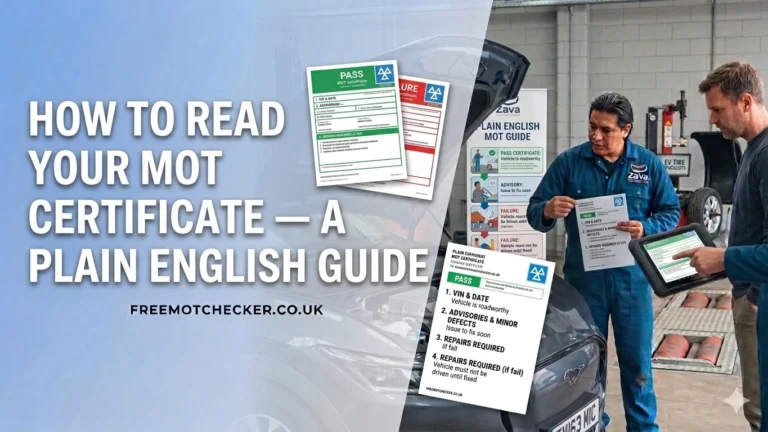
What if I pass the test early but then my car gets damaged before the old expiry date? The certificate is valid from the test date. If your car is involved in an incident or a component fails after the MOT, the certificate still stands — it confirms roadworthiness on the test day only, not ongoing. See our guide: How to read your MOT certificate — a plain English guide for what the certificate does and does not guarantee.
Does testing early affect my car insurance? No. A valid MOT certificate is a valid MOT certificate regardless of how far in advance it was obtained. Testing early within the window does not create any gap or change in your insurance position.
What if I have advisory notes from the early test — do I need to fix them before the original expiry date? No. Advisory notes are not legally binding regardless of timing. Your car has passed and is legal to drive. That said, acting on advisories promptly is always recommended — they represent components approaching the point of failure. For guidance on how seriously to take each type of advisory: What do MOT advisory notes mean — and do you have to fix them?
I tested on the exact day — one month minus one day — and the garage says the renewal date has changed. Is that right? Check the calculation again. The rule is one calendar month minus one day. Months vary in length, so the exact number of days differs — May to June is 31 days, so one month minus one day before a 15 June expiry is 16 May, not 14 May. If you believe the garage or the DVSA system has calculated incorrectly, verify using our free MOT checker to see what expiry date has been recorded.
Last reviewed: April 2026. Based on official GOV.UK and DVSA guidance on MOT timing and early renewal rules.
Written by Haseeb — Founder, Free MOT Checker. All guides are reviewed against current DVSA standards and UK motoring law.