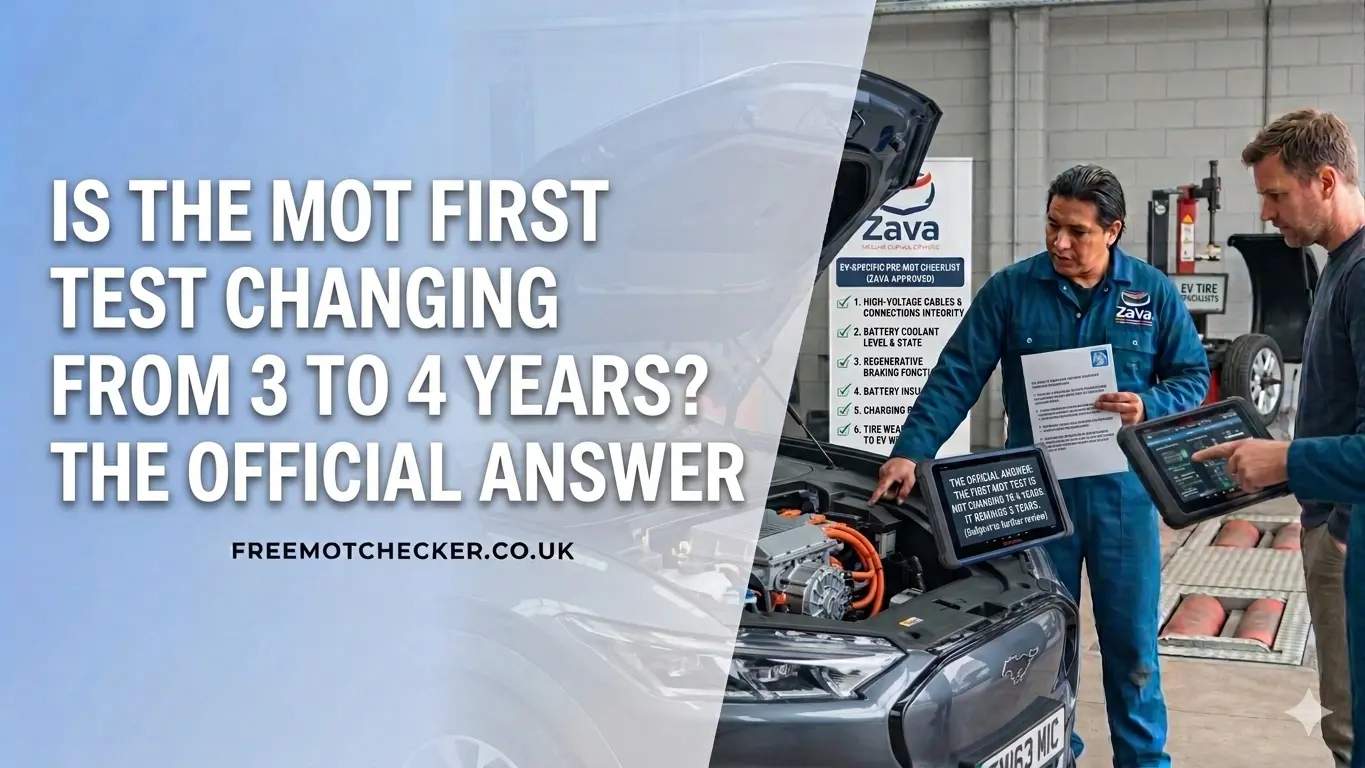
No — and it has been officially rejected. Despite widespread speculation, government consultations, and persistent rumours online, the age at which your car needs its first MOT is not changing in 2026. The “3-1-1” rule remains firmly in place: your first MOT is due three years after your vehicle was registered, followed by an annual test every year after that.
This guide explains the full history of the 4-year proposal, why the government decided against it, the one part of the UK where a 4-year first MOT already applies, and exactly how to work out when your car’s next test is due.
What Is the “3-1-1” Rule?
The current MOT schedule works like this:
- First MOT: due exactly three years after the date of first registration
- Every year after that: a new MOT is required annually to keep the vehicle legally roadworthy
This structure has been in place for decades and continues unchanged into 2026 and beyond. It applies to all standard cars, vans, and light commercial vehicles registered in England, Scotland, and Wales.
The informal name “3-1-1” refers to the three-year wait before the first test, followed by one-year intervals indefinitely.
What Was the 4-Year Proposal?
Over the past several years there was a genuine government consultation on extending the first MOT from three years to four — sometimes called the “4-1-1” proposal. The idea attracted attention for two reasons:
The argument for extending to 4 years
Modern vehicles are significantly more reliable than cars built twenty or thirty years ago. Manufacturers now routinely offer five-year warranties, and the rate of safety failures on three-year-old cars at their first MOT is lower than it was historically. Proponents argued that extending the first test interval would reduce costs for new car owners and reflect the improved engineering standards of contemporary vehicles.
The argument against
Safety organisations, the DVSA, and road safety campaigners pushed back firmly. Their core concern was straightforward: even if the average three-year-old car is more reliable than it used to be, a significant proportion still fail their first MOT. Extending the interval would leave vehicles with undetected safety defects — worn tyres, lighting faults, brake issues — on public roads for an additional year without any official check.
The government sided with the safety argument. Ministers confirmed that the risk to road safety outweighed the financial benefit to individual drivers, and the 4-year proposal was dropped.
The Official Position in 2026
The government has confirmed clearly and formally that:
- The first MOT remains due at three years — no change in 2026 or the near future
- Annual testing continues — there is no change to the frequency of subsequent MOTs
- No new consultation is underway — there is no active government review of MOT intervals at the time of writing
For a full breakdown of what is changing in 2026 — including the new tester discipline rules and EV-specific inspection checks — see our guide: MOT test changes 2026 — what every UK driver needs to know.
The One Exception: Northern Ireland
There is one part of the UK where a longer first-test interval already applies, and it is worth knowing about if you are based there or have recently moved.
In Northern Ireland, the first MOT is due when the vehicle is four years old, not three. After that first test, Northern Ireland vehicles follow the same annual testing schedule as the rest of the UK.
This difference has existed for some time and is not a new 2026 change. It reflects the separate vehicle testing arrangements that apply in Northern Ireland, where tests are carried out through the Driver & Vehicle Agency (DVA) rather than through DVSA-approved garages.
If you have a Northern Ireland-registered vehicle, your first test is due four years after the date of first registration. All subsequent tests are annual.
When Exactly Is Your First MOT Due?
The date is calculated from your vehicle’s date of first registration, not the date you bought it. This is the date printed on your V5C logbook under “date of first registration.”
Example: If your car was first registered on 15 June 2022, its first MOT is due on or before 15 June 2025. It must have a valid certificate from that date onwards to be driven legally.
You can check your exact MOT due date instantly — no paperwork needed — using our free MOT checker. Enter your registration number and the result shows your current MOT status, expiry date, and full test history.
Can You Book Your First MOT Early?
Yes — and in many cases it makes sense to do so. You can book your car’s first MOT up to one month (minus a day) before the due date without losing any time on the new certificate.
For example, if your MOT is due on 15 June, you can have the test carried out as early as 16 May. Your new certificate will still run until 15 June the following year — you do not lose the time between the test date and the original due date.
This is particularly useful if you are buying or selling a vehicle close to its MOT due date. For more on how early booking works, see our guide: Can you get an MOT a month early without losing certificate time? (coming soon)
What Happens If You Miss the Due Date?
If your vehicle’s MOT expires and you continue driving it, you are breaking the law — even if the car is in perfect working condition. The consequences include:
- A fine of up to £1,000 for driving without a valid MOT
- Your car insurance may be invalidated — meaning any claim could be rejected
- Penalty points on your licence in certain circumstances
- The vehicle may be seized by police in serious cases
The only exception is driving to a pre-booked MOT appointment via a direct route — this is the one circumstance where driving without a valid certificate is legally permitted. See our guide on whether you can drive to an MOT without a valid certificate (coming soon) for the exact rules.
For full detail on fines and what happens if your MOT expires, see our guide: What happens if your MOT expires — can you still drive? (coming soon)
Does a New Car Need an MOT Straight Away?
No. A brand-new car purchased from a dealership does not need an MOT until it is three years old. The date of first registration — the date it was sold and registered for the first time — is the starting point for the three-year clock.
If you buy a nearly-new used car that is already two years old, its first MOT will be due within the following year. Always check the registration date on the V5C before purchasing, so you are not caught out by an MOT due date arriving sooner than expected.
Before buying any used vehicle, it is also worth checking its full MOT history using our free MOT history checker or car history check tool — both show every past test result, advisory note, mileage record, and pass or fail since the vehicle’s first test.
What About Classic Cars — Do They Still Need an MOT?
Vehicles that are more than 40 years old and have not been substantially modified are exempt from the MOT requirement. This is known as the classic car MOT exemption and has been in place since 2018.
However, being exempt does not mean being above the law. Classic car owners are still legally responsible for ensuring their vehicle is roadworthy. Police can stop and inspect any vehicle at any time, and driving an unsafe classic car carries the same legal consequences as driving any other unroadworthy vehicle.
For the full rules on who qualifies and what counts as a “substantial modification,” see our guide: Classic car MOT exemption — the 40-year rule explained (coming soon)
Frequently Asked Questions
Is the MOT changing to 4 years in 2026? No. The government has officially rejected the 4-year proposal. The first MOT remains due three years after a vehicle’s date of first registration, and annual testing continues from that point.
Does the 4-year first MOT apply anywhere in the UK? Yes — in Northern Ireland, the first MOT is due at four years rather than three. This is not a 2026 change; it has applied in Northern Ireland for some time under the separate DVA testing system.
How do I find out when my MOT is due? Enter your registration number into our free MOT checker. You will immediately see your current MOT status and the exact expiry date.
What if I bought a used car and I’m not sure when the MOT is due? Check the date of first registration on your V5C logbook, or use our MOT history checker — it pulls the registration date and full test history directly from the DVSA database.
Can I drive my new car before it needs an MOT? Yes. A brand-new car does not require an MOT until its third anniversary of first registration. You can drive it freely until that date, provided it remains roadworthy.
What were the 2026 MOT changes that did happen? The actual 2026 changes focus on tighter rules for MOT testers and new EV inspection checks — not on test intervals or frequencies. See our full guide: MOT test changes 2026 for everything that is and is not changing.
Last reviewed: April 2026. Based on confirmed government and DVSA guidance on MOT test intervals.
Written by Haseeb — Founder, Free MOT Checker. All guides are reviewed against current DVSA standards and UK motoring law.