Yes, electric cars need an MOT. Despite having no exhaust system and zero tailpipe emissions, every electric vehicle (EV) in the UK must pass its first MOT three years after registration, then annually from that point forward. The legal requirement is identical to petrol and diesel cars.
What is different is what gets checked — and from April 2026, the DVSA has introduced new EV-specific inspection requirements that every electric car owner should understand before booking their next test.
Do Electric Cars Need an MOT in the UK?
Yes — without exception. Once your EV reaches its third anniversary of registration, it must hold a valid MOT certificate to be driven legally on UK roads. After that first test, you need a new certificate every 12 months.
This applies to all fully electric vehicles regardless of brand, battery size, or range. It also applies to plug-in hybrids (PHEVs) and mild hybrids. Driving without a valid MOT can result in a fine of up to £1,000 and will typically invalidate your car insurance — even if the vehicle is in perfect working order.
You can check your EV’s current MOT status, expiry date, and full test history for free using our MOT history checker.
What Changed for Electric Vehicle MOTs in 2026?
New EV visual safety checks — from 1 April 2026
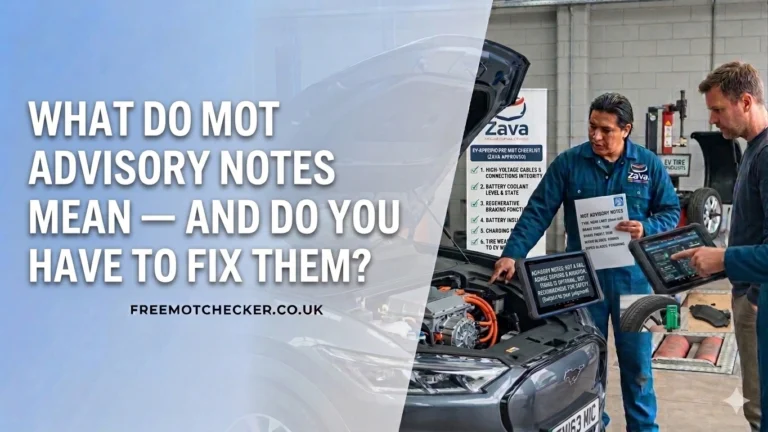
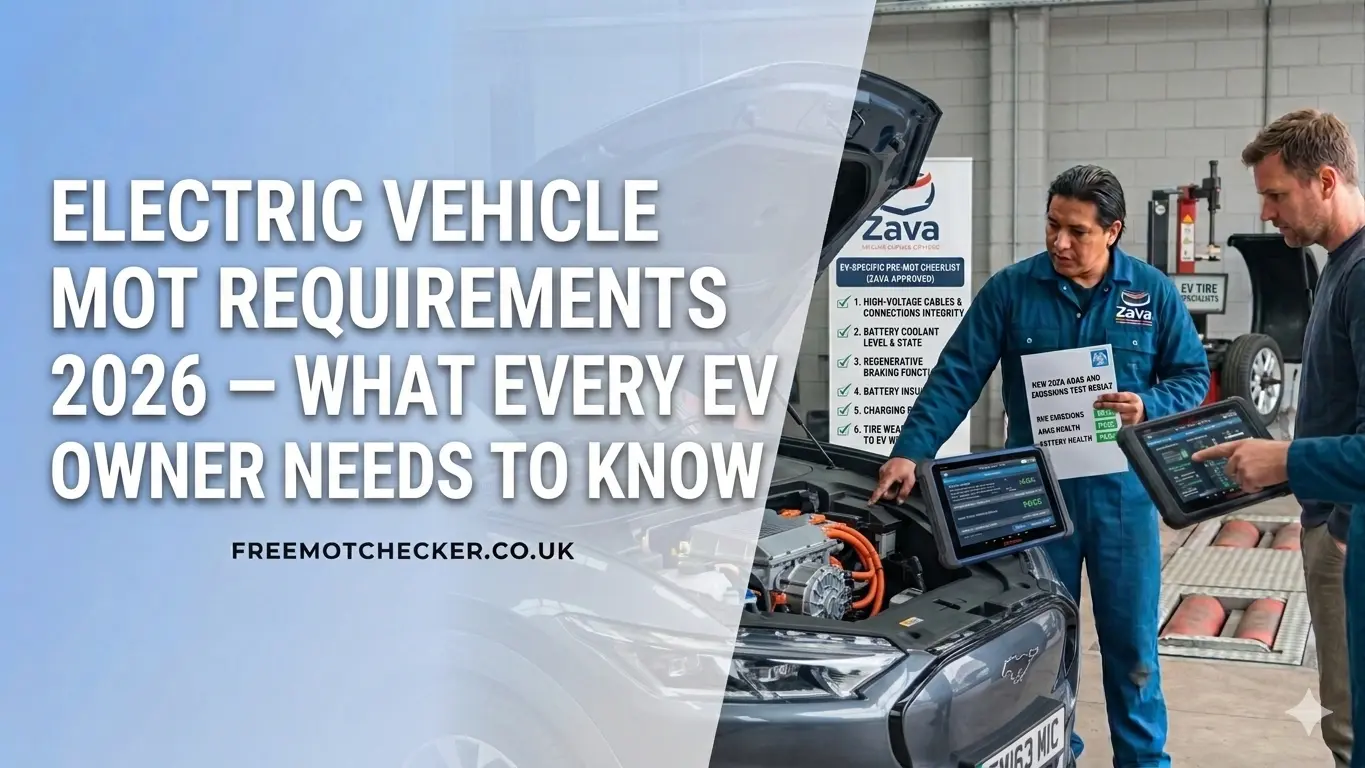
From 1 April 2026, the DVSA updated the MOT Inspection Manual to include specific visual checks for electric and hybrid vehicles that did not previously exist as formal requirements. MOT testers are now required to inspect:
High-voltage cables Electric vehicles use high-voltage wiring — usually identifiable by bright orange casing — to carry power between the battery, motor, and charging system. Testers must visually inspect these cables for signs of damage, fraying, or compromised insulation. The DVSA has issued strict safety guidance noting that damaged high-voltage components can deliver fatal electric shocks. If any HV wiring shows visible damage, this will result in an immediate Major Fail.
The charging port The vehicle’s charging port is now subject to a formal visual inspection for damage, corrosion, or structural issues that could affect safety during charging.
The traction battery and its mountings EVs are significantly heavier than equivalent petrol cars — largely because of the battery pack. Testers now inspect the battery housing and its mounting points for signs of damage, leaks, or corrosion that could compromise the structural integrity of the vehicle. A damaged or poorly secured battery is a safety risk both in normal driving and in the event of a collision.
What happens if something fails the EV-specific checks?
Defects found during the high-voltage or battery inspection are classified in the same way as any other MOT failure:
- Dangerous defect — the vehicle cannot be driven away and must be recovered
- Major defect — must be repaired before the vehicle can be used on the road
- Minor defect — noted as an advisory; does not cause a failure but should be monitored
For a full explanation of defect categories, see our guide: What is a major MOT defect — can you drive home after failing? (coming soon)
New equipment standards for heavier EVs
From the same date, new and significantly modified MOT test centres must use jacking equipment with a minimum 2-tonne safe working load and 1,700mm lifting pad spacing. This directly addresses the fact that many electric vehicles — particularly large SUVs and premium models — weigh considerably more than the cars these garages were originally equipped to handle.
This is a garage compliance requirement rather than something that affects your booking experience, but it is worth confirming your test centre is equipped to handle your specific EV before booking, particularly if you drive a heavier model such as a large electric SUV.
For more detail on the 2026 equipment and tester rule changes, see our full guide: MOT test changes 2026 — what every UK driver needs to know.
What Gets Checked on an Electric Car MOT?
An EV MOT follows the same structure as any other vehicle test, but some sections differ because of the fundamental differences in how electric cars work.
Checks that are the same as petrol and diesel cars
- Brakes — pads, discs, handbrake, and braking performance
- Tyres — tread depth (minimum 1.6mm), condition, and pressure
- Lights and indicators — headlights, brake lights, fog lights, hazards
- Steering and suspension — wear, leaks, and structural condition
- Windscreen — cracks, chip severity, and wiper effectiveness
- Seatbelts — operation, condition, and retraction
- Horn — function and audibility
- Mirrors — presence and condition
- Bodywork — structural damage that could affect safety
Checks specific to electric vehicles
- High-voltage cables — visual inspection for damage (from April 2026, formally required)
- Charging port — visual inspection for damage or corrosion
- Traction battery mountings — checked for security and structural integrity
- Regenerative braking systems — tested as part of overall brake assessment
- Warning indicators — any illuminated warning light for safety-critical systems (battery, motor, ABS, or airbag) can result in a failure
What is NOT checked on an EV MOT
Because electric cars have no internal combustion engine, several sections of the standard MOT simply do not apply:
- No exhaust test — EVs have no tailpipe or exhaust system
- No emissions test — no exhaust means no emissions check
- No fuel system inspection — no fuel tank, lines, or injectors
- No engine noise assessment — electric motors operate silently
This means an EV MOT is typically slightly quicker than a petrol or diesel equivalent — usually 40 to 55 minutes rather than the standard 45 to 60.
How Much Does an Electric Car MOT Cost?
The maximum MOT fee for an electric car is the same as for any other car: £54.85, as set by the DVSA. Garages cannot legally charge more than this for a standard Class 4 vehicle, regardless of whether it is electric, petrol, or diesel.
In practice, many garages charge between £35 and £50 to remain competitive. It is worth shopping around, particularly in areas with several DVSA-approved test centres nearby.
If your EV fails and you need a retest, see our guide on MOT retest rules — free retest conditions, fees and time limits for what you are entitled to.
Common Reasons Electric Cars Fail Their MOT
Despite having fewer mechanical components than petrol cars, EVs still fail their MOT — often for surprisingly straightforward reasons.
Tyre wear — particularly inner edge wear The extra weight of battery packs puts greater stress on tyres, especially the inner edges. Many EV drivers are caught out at MOT time because inner-edge wear is less visible during a casual inspection. Check the full width of each tyre, not just the centre tread. The legal minimum depth is 1.6mm.
Brake issues — rust and seized callipers Because EVs use regenerative braking to slow down in everyday driving, the physical brake components are used less frequently. This sounds like a benefit — and it often is — but it also means brake discs and callipers can develop surface rust or seize up from lack of use. If your EV sits unused for extended periods, the brakes may need attention before your MOT.
Warning lights Any illuminated warning light related to a safety-critical system — including the battery, motor, ABS, airbag, or electronic stability control — will typically result at minimum in a Major defect. Do not attend your MOT with unresolved warning lights.
Lighting faults Lighting failures are the single most common MOT failure across all vehicle types, accounting for nearly 13% of all initial failures. Check every bulb, including the often-forgotten rear fog light and number plate lights, before your appointment.
Windscreen damage A chip or crack in the driver’s line of vision — specifically in the swept area of the windscreen directly in front of the driver — can result in failure. A crack of more than 10mm in the A zone (40mm band centred on the steering wheel) is an automatic fail. See our guide on whether a cracked windscreen fails an MOT (coming soon) for the exact rules.
Do I Need a Specialist EV Garage for My MOT?
Not necessarily — but it matters. All DVSA-approved test centres can legally carry out MOT tests on electric vehicles, provided their testers have received appropriate training in high-voltage safety. From April 2026, the updated inspection manual specifically states that only EV-trained technicians should handle high-voltage components.
Before booking, it is worth confirming that your chosen garage has:
- Testers with DVSA-approved EV safety training
- Equipment capable of safely lifting your vehicle (particularly relevant for heavier EV models)
- Experience testing electric vehicles regularly
If you have recently purchased a used EV and want to understand its full test history before its next MOT, use our free car history check or MOT history checker to see every past result, advisory, and mileage record.
Do Plug-in Hybrids and Mild Hybrids Need an MOT?
Yes — and their MOT is more comprehensive than a pure EV’s.
Plug-in hybrids (PHEVs) combine an electric motor with a combustion engine. This means they are subject to the full standard MOT, including exhaust and emissions testing for the combustion engine, plus the new EV-specific checks for the high-voltage system and battery.
Mild hybrids (MHEVs) that use the electric motor only to assist the combustion engine — rather than drive the car independently — follow the standard petrol or diesel MOT process with emissions testing included.
How to Prepare Your EV for Its MOT
These quick checks take under 15 minutes and can save you the cost and inconvenience of a retest:
- Check all lights — walk around the car and test every light function including indicators, reverse lights, and number plate illumination
- Inspect all four tyres — check tread depth across the full width, look for inner-edge wear, and check pressures
- Check the windscreen — inspect for chips or cracks, particularly in the driver’s direct line of vision
- Look for warning lights — resolve any active warning lights before attending; if a light came on recently and you do not know why, have it diagnosed first
- Check wiper blades and screenwash — running out of screenwash during the wiper test is a simple avoidable failure
- Look under the car — if you can safely do so, visually check that the orange high-voltage cables running beneath your EV show no signs of visible damage or chafing
Frequently Asked Questions
Does an electric car need an emissions test at MOT? No. EVs produce no exhaust emissions and have no tailpipe, so the emissions test does not apply. This is one of the main practical differences between an EV MOT and a petrol or diesel one.
What happens if a high-voltage cable fails the inspection? Visible damage to a high-voltage cable will result at minimum in a Major defect, meaning you cannot legally drive the vehicle until it is repaired and retested. If the tester considers it a danger to the occupants or other road users, it may be classified as a Dangerous defect.
Is there a separate MOT for electric cars in 2026? No. There is no new standalone EV MOT. Electric cars are tested under the same Class 4 MOT framework as petrol and diesel vehicles. The April 2026 updates added specific visual checks within the existing test structure.
Can I drive my EV to the MOT without a valid certificate? You may legally drive to a pre-booked MOT appointment without a valid certificate, but only for that purpose and only via a reasonable direct route. You cannot use this as general permission to drive the car. See our guide on whether you can drive to an MOT without a valid certificate (coming soon) for full details.
When is my EV’s first MOT due? Three years after the date of first registration. You can check the exact due date instantly using our free MOT checker — enter your registration number and the result shows your current status and expiry date.
Last reviewed: April 2026. Information based on DVSA MOT Inspection Manual updates effective 1 April 2026 and current UK motoring law.
Written by Haseeb — Founder, Free MOT Checker. All guides are reviewed against current DVSA standards and UK motoring law.