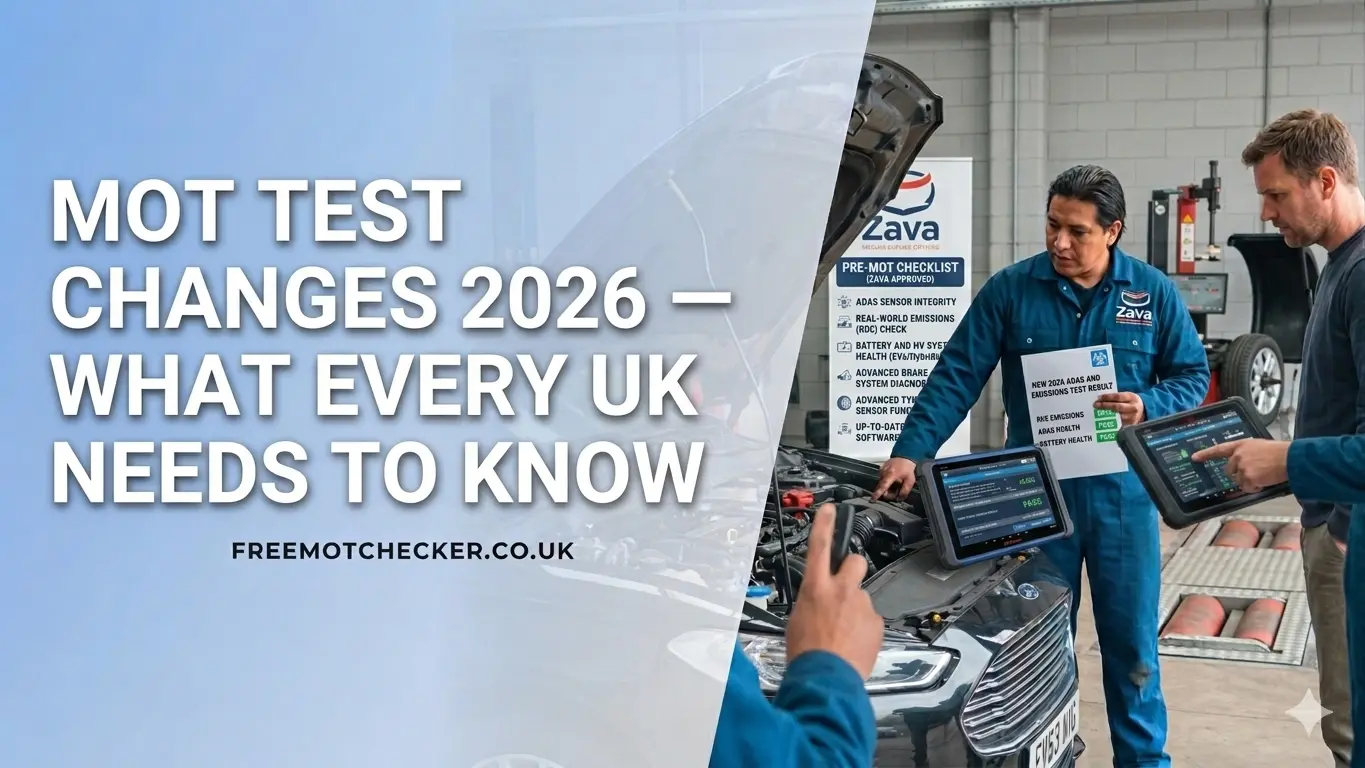
If you have an MOT due this year, you may have seen headlines about new rules coming into force in 2026. The short answer is this: the MOT test itself has not changed. You will not face new inspection items or tougher failure categories. What has changed is how the system is managed behind the scenes — and those changes are designed to protect you as a driver.
This guide explains every 2026 MOT change in plain English, what it means for your next appointment, and what remains exactly the same.
What Is Changing in 2026 — Quick Summary
| Change | Effective date | Who it affects |
|---|---|---|
| Stricter rules for suspended MOT testers | 9 January 2026 | MOT garages and testers |
| New jacking equipment standards | 1 April 2026 | New and modified test centres |
| Stronger anti-fraud measures (ghost MOTs) | Ongoing throughout 2026 | All MOT test centres |
| MOT frequency, fees, and test items | Not changing | All UK drivers |
Change 1 — Stricter Rules for MOT Testers (From 9 January 2026)
The biggest change in 2026 focuses not on what is checked on your car, but on who is allowed to carry out the check.
From 9 January 2026, the DVSA introduced new rules under Special Notice 05-25 that significantly tighten disciplinary controls on MOT testers and Authorised Examiner Principals (AEPs) — the people who run MOT test stations.
What is a cessation?
A cessation is a formal ban issued by the DVSA when an MOT tester or garage operator seriously breaks the rules. The DVSA can issue two-year or five-year cessations for offences including:
- Fraud or dishonesty
- Gross negligence during testing
- Producing false documents
- Criminal convictions that undermine trust in the MOT system
Under the old rules, a loophole allowed some banned individuals to continue being involved in MOT operations indirectly — working through a partner, family member, or different garage. The 2026 changes close that loophole completely.
What the new rules mean
From January 2026, anyone placed under a two-year or five-year cessation is:
- Completely banned from holding any MOT-related role for the full duration of the ban
- Prevented from working indirectly through another person, garage, or business
- Subject to heavier penalties for serious offences including fraud and false documentation
The official MOT Testing Guide was updated on 9 January 2026 to formally reflect these rules.
What does this mean for you as a driver?
Directly, very little changes about your MOT experience. Indirectly, this is good news. It means the DVSA is cracking down on dishonest garages and unqualified testers — reducing the risk that your vehicle is passed by someone who should not be doing the job. The MOT certificate you receive from a reputable garage now carries stronger assurance that it was issued by a properly qualified and accountable tester.
Change 2 — New Garage Equipment Standards (From 1 April 2026)
From 1 April 2026, the DVSA introduced updated specifications for the jacking equipment that MOT centres use to lift vehicles during inspection.
The new standards require:
- A minimum safe working load of 2 tonnes
- A minimum lifting pad distance of 1,700mm
Why is the equipment changing?
Today’s vehicles are significantly heavier than they were ten years ago. Electric cars, hybrid SUVs, and large family vehicles often weigh considerably more than older petrol models — and some older lifting equipment cannot safely support them. The updated standards ensure that every vehicle can be raised safely and inspected properly.
Does this affect your MOT appointment?
For most drivers, no. The new equipment standards apply only to:
- Newly opened MOT test centres
- Existing centres that are changing ownership
- Centres adding new test lanes
- Centres restarting MOT testing after six or more months of inactivity
If your usual garage has been operating without major changes, it is not required to upgrade its equipment immediately. However, any garage expanding or opening after April 2026 must meet the new standard from the outset.
Change 3 — Crackdown on Ghost MOTs and Fraud
Throughout 2025 and 2026, the DVSA has strengthened its systems to detect and prevent “ghost MOTs” — fraudulent certificates issued for vehicles that were never actually tested or that were passed without proper inspection.
Ghost MOTs are a genuine problem. In some reported cases, fake certificates have been sold online for as little as £100, putting unsafe vehicles on UK roads and exposing honest drivers to invalidated insurance.
The DVSA is tackling this through:
- Advanced data analytics that flag suspicious patterns, including tests completed in under 20 minutes (a proper MOT takes 45 to 60 minutes)
- Photographic evidence requirements linking the vehicle to its test record
- Expanded conviction reporting requirements for testers
- Tougher oversight of garages with abnormally high pass rates or no corresponding failure records
For drivers, the practical benefit is greater confidence that your MOT certificate genuinely reflects your vehicle’s condition.
What Is NOT Changing in 2026
There has been significant speculation online about potential changes to the MOT. It is worth being clear about what is confirmed as staying the same:
MOT frequency — There is no change. Your first MOT is still due three years after your vehicle was first registered, and annually from that point forward. Despite government consultations in previous years about extending the interval to four years, ministers confirmed this will not happen in 2026.
MOT test items — The components inspected during your MOT have not changed. Brakes, tyres, lights, steering, suspension, seatbelts, emissions, and windscreen visibility are all checked exactly as before.
Maximum test fee — The DVSA maximum fee remains £54.85 for a standard car (Class 4) and £29.65 for motorcycles. Most garages charge between £35 and £50.
The three-year first MOT rule — Confirmed unchanged. Your car needs its first MOT exactly three years after registration, not four.
MOT Failure Rates in 2025–26 — What Is Most Likely to Fail
Understanding why vehicles fail helps you prepare. According to the latest DVSA data, roughly 28.9% of cars fail their initial MOT test. The most common reasons are:
- Lighting faults (12.75% of failures) — bulbs, alignment, and indicator function
- Suspension issues (10.67%) — worn components, leaks, and damage
- Tyre problems (10.05%) — insufficient tread depth, damage, or incorrect pressure
These are all things you can check yourself before your appointment. A quick walk around your car checking lights, tyre tread depth, and tyre pressure takes less than ten minutes and could save you a retest fee.
How to Prepare for Your MOT in 2026
The 2026 changes make it more important than ever to use a reputable, DVSA-approved test centre. Here is how to prepare:
- Check your MOT history before your appointment — use our free MOT checker to review past advisories and any recurring faults.
- Check all exterior lights — walk around the car and test headlights, brake lights, indicators, and fog lights.
- Check tyre tread depth — the legal minimum is 1.6mm across the central three-quarters of the tyre. Use a 20p coin: if the outer rim of the coin is visible when inserted into the tread groove, your tyres may be below the limit.
- Top up screenwash — running out during a wiper test is a simple avoidable failure.
- Look up your garage — search for DVSA-approved test centres and check reviews before booking.
Frequently Asked Questions
Will the MOT test itself be harder to pass in 2026? No. No new inspection items or failure categories have been introduced. The test checks the same components as before.
Do the January 2026 tester rules affect drivers directly? Not directly. The new rules restrict suspended MOT testers from holding roles at garages. As a driver, the effect is improved confidence that your tester is qualified and accountable.
Is the first MOT moving from three years to four years? No. Despite government consultations, this change has not been introduced. Your first MOT is still due three years after your vehicle’s registration date.
How can I check if my MOT is due? Enter your registration number into our free MOT checker for your current status, expiry date, and full test history.
What is a ghost MOT? A ghost MOT is a fraudulent certificate issued for a vehicle that was never properly tested. The DVSA is cracking down on these throughout 2026 with improved detection systems and stricter garage oversight.
Last reviewed: April 2026. All information based on official DVSA guidance and Special Notice 05-25.
Written by Haseeb — Founder, Free MOT Checker. All guides are reviewed against current DVSA standards and UK motoring law.