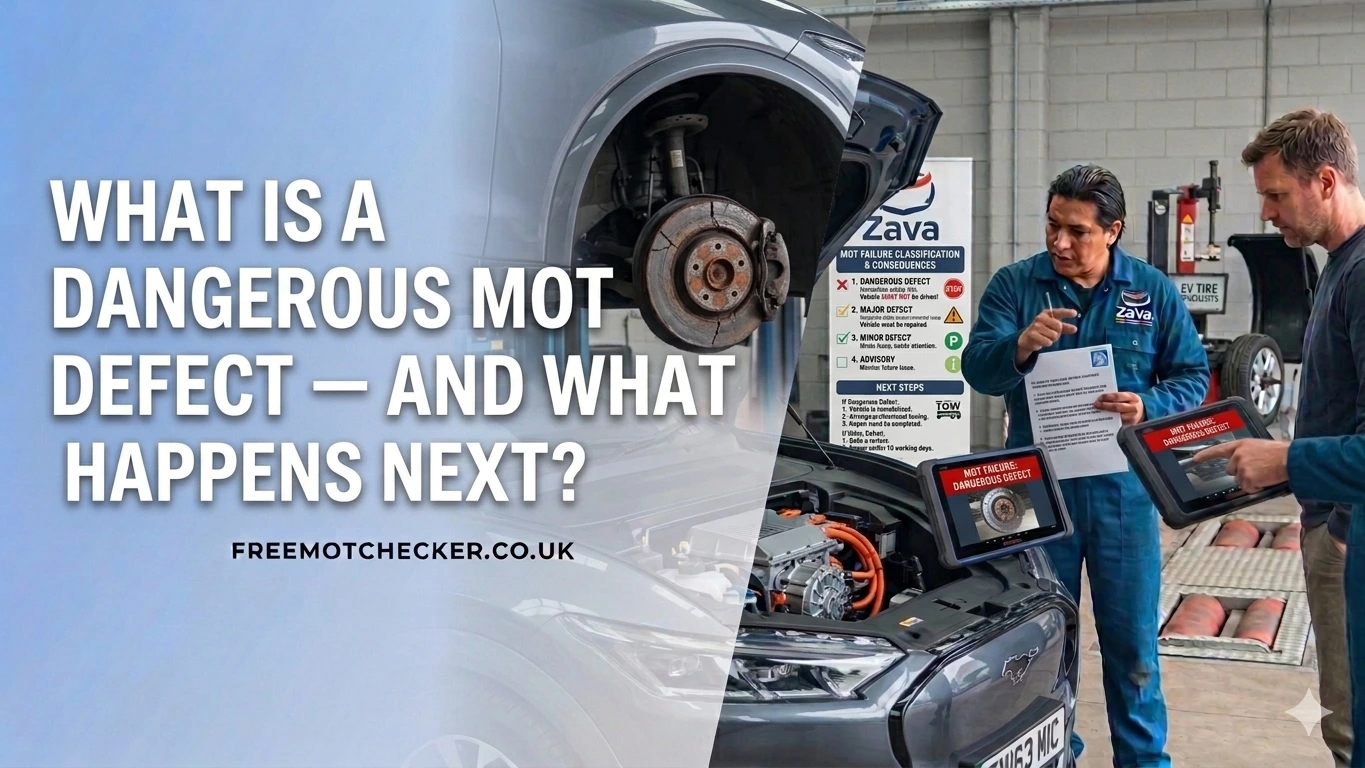
A dangerous MOT defect means your car is unroadworthy and must not be driven — full stop. Unlike a major defect, there are no exceptions based on your previous certificate, no grey areas about short journeys, and no question of driving carefully to a nearby garage. A dangerous defect is the most serious verdict a tester can give, and the consequences of ignoring it are significant.
This guide explains exactly what a dangerous defect is, how it differs from a major defect, what the most common examples are, and precisely what your options are the moment one appears on your VT30.
Where Dangerous Defects Sit in the MOT System
The MOT uses three formal defect categories, plus advisory notes. Understanding where dangerous defects sit explains why they are treated so differently from everything else.
| Category | Causes failure? | Can you drive away? |
|---|---|---|
| Dangerous | Yes | No — under any circumstances |
| Major | Yes | Only if previous MOT still valid and car is roadworthy |
| Minor | No — car passes | Yes |
| Advisory | No — car passes | Yes |
A dangerous defect sits entirely in its own category. The DVSA defines it as a fault that poses a direct and immediate risk to road safety — something that could cause an accident, injure someone, or result in catastrophic mechanical failure without warning.
For context on how major and minor defects work, and the nuance around driving after a major failure, see our guide: What is a major MOT defect — and can you drive home after failing?
What Counts as a Dangerous MOT Defect?
The DVSA MOT Inspection Manual lists specific threshold criteria for every testable component. A dangerous classification is applied when the tester determines that a fault represents an immediate hazard — not just a deteriorating component, but one that is already unsafe under normal driving conditions.
Common examples include:
Brakes
- Brake failure or near-total loss of braking performance on any wheel
- A severely leaking brake line that has reduced hydraulic pressure significantly
- A brake disc cracked through its thickness or sheared from its hub
- Braking performance so imbalanced that the car pulls dangerously under emergency braking
Tyres
- Tread depth effectively zero — cord or fabric structure visible through the rubber
- A large cut, bulge, or separation in the tyre sidewall that could cause a blowout
- A tyre that is completely flat or structurally compromised
- A tyre whose load rating is dangerously insufficient for the vehicle’s weight
Steering
- Steering so worn or loose that directional control cannot be maintained safely
- A steering joint or rack component at risk of sudden complete failure
- Play in the steering column severe enough to make the vehicle unpredictable
Suspension
- A suspension component completely detached or fractured
- Severe structural corrosion around a suspension mounting point that could collapse
- A wheel bearing so badly worn that wheel separation is a realistic risk
Windscreen and visibility
- A crack or damage in the driver’s primary line of vision so significant that safe driving is impossible
- Wiper failure that renders the windscreen uncleanable during rain
Fuel system
- A continuous fuel leak — not a weep, but an active drip or flow that creates fire risk
- A fuel line in contact with a heat source or sharp edge and on the verge of failure
Structural
- Severe corrosion or fracture of the chassis, floor pan, or body structure in load-bearing areas to the point that the vehicle’s structural integrity is compromised
Other
- No functioning brake lights on any circumstances — any driver behind the vehicle cannot tell it is stopping
- A seized handbrake that cannot be released, making movement dangerous
- For electric vehicles: visible damage to high-voltage orange cabling (a formal dangerous defect from April 2026 under updated DVSA guidance — see our guide on electric vehicle MOT requirements 2026)
Can You Drive Away With a Dangerous Defect?
No. This is the clearest rule in the entire MOT system.
According to official GOV.UK guidance, driving a vehicle with a dangerous MOT defect can result in:
- A fine of up to £2,500
- Three penalty points on your licence
- A potential driving ban
Crucially, these penalties apply regardless of whether your previous MOT certificate is still valid. A valid certificate does not give you the right to drive an unroadworthy vehicle — it never has. The dangerous classification simply makes this explicit and removes any possible ambiguity.
There is one important practical nuance that often causes confusion: MOT test centres have no legal authority to stop you from driving away. The DVSA has confirmed this directly. The garage cannot physically detain the vehicle, hold your keys, or impound the car. They can — and should — advise you clearly that driving is illegal and unsafe. But if you choose to drive, that is your decision, and the full legal and insurance consequences rest with you.
The responsible course of action is straightforward: do not drive the car.
What Are Your Options if Your Car Has a Dangerous Defect?
Option 1 — Arrange recovery
The cleanest and safest option. Call a recovery service to transport the vehicle directly to a garage that can carry out the repairs. Keep the VT30 certificate with you — it lists the dangerous defect and will help the repairing garage prioritise the right work.
Option 2 — Have the repairs done on-site
If the test centre also offers repair services and the defect can be fixed the same day, this is the most efficient route. Once repairs are complete, you can book a retest — either a partial retest covering only the failed items if done within 10 working days, or a full retest if more time passes or you move to a different garage.
For the full rules on retest fees and timescales, see: MOT retest rules — free retest conditions, fees and time limits
Option 3 — Appeal the decision
If you genuinely believe the dangerous defect classification is wrong — that the tester has misidentified a fault or applied the wrong severity level — you have the right to appeal to the DVSA. Submit form VT17 on GOV.UK within 14 working days of the failed test. Crucially, you must not make any repairs before the appeal is assessed. A DVSA vehicle examiner will inspect the vehicle in its original condition before ruling on your appeal.
Appeals are relatively uncommon and the bar is high — the tester’s assessment carries significant weight. But if you have strong reason to believe the classification was incorrect, it is a legitimate option.
Does a Dangerous Defect Affect Your Insurance?
Yes — significantly. Your car insurance may be invalidated in two ways:
If you drive the car: Any insurer can legitimately refuse to pay a claim if you drove a vehicle in a condition you knew was classified as dangerous. Driving with a dangerous defect is not just illegal — it is precisely the kind of deliberate, reckless act that voids insurance coverage.
If an incident occurs while parked: This is less commonly understood. If your vehicle is parked on a public road and causes harm due to a known dangerous defect — a wheel separating, a fuel leak causing fire — your insurer may argue you were negligent in leaving an unroadworthy vehicle where it could cause danger.
The safest position after a dangerous defect finding is to have the vehicle recovered immediately rather than leaving it in a public space.
Dangerous vs Major Defect — A Clear Comparison
Many drivers confuse the two, partly because both cause an MOT failure. The distinction comes down to immediacy of risk.
| Dangerous | Major | |
|---|---|---|
| Risk level | Immediate — could cause accident now | Significant — safety compromised but not at breaking point |
| Drive away? | Never | Only if previous cert valid + car roadworthy |
| Previous cert valid? | Makes no difference | Could allow limited driving |
| Insurance while driving? | Almost certainly void | At risk if involved in incident |
| Fine for driving? | Up to £2,500 + 3 points + ban | Up to £1,000 (no valid MOT) |
| Garage authority to stop you? | None — your decision | None — your decision |
What Happens at the Retest After Repairs?
Once the dangerous defect has been repaired by a qualified mechanic, you book a retest at a DVSA-approved test centre. If you return to the same garage that carried out the original test and the repairs are completed within 10 working days, you qualify for a partial retest — only the items that failed are re-checked, at a reduced fee.
If you take the car to a different garage for repair, or if more than 10 working days pass, a full MOT is required at the standard fee.
After passing the retest, your new MOT certificate will appear in the DVSA database immediately. Confirm your new expiry date using our free MOT checker — enter your registration number to verify the updated record is showing correctly.
For more on what to expect after any MOT failure, including dangerous defects: What happens after an MOT fail — clear steps, rules, and your options
How to Avoid Dangerous Defects Before Your Next MOT
The single most effective prevention strategy is acting on advisory notes before they deteriorate into dangerous defects. The progression is almost always gradual — an advisory about tyre tread, ignored across two MOT cycles, becomes a major defect, then a dangerous one. Addressing advisories promptly breaks that chain before it reaches the most severe outcome.
You can view every advisory your vehicle has ever received — including from all previous owners — using our free MOT history checker. If you have recently bought a used car and want to understand its full maintenance history before its next test, our car history check shows the complete record.
Before every MOT, a 15-minute pre-check of the most common dangerous defect areas — tyres, lights, brakes, and windscreen — can identify obvious issues before the tester does. For a full preparation checklist: How to prepare your car for an MOT
Frequently Asked Questions
Can the garage legally keep my car if it has a dangerous defect? No. MOT test centres have no legal power to detain a vehicle, even one with a dangerous defect. They can and should advise you clearly that driving is illegal. The decision — and the full legal consequences — are yours alone.
What if I only have a dangerous defect and no major defects? A single dangerous defect is enough to fail the MOT and prohibit driving. You do not need multiple defects for the most severe classification to apply.
Does a dangerous defect cancel my existing MOT certificate? Not technically — but it makes the certificate irrelevant. A valid certificate does not permit you to drive an unroadworthy vehicle. The dangerous defect overrides it entirely from a legal roadworthiness perspective.
Can I get the car towed rather than driving it? Yes — recovery on a flatbed or trailer is perfectly legal and is the recommended option when driving is prohibited. The vehicle does not need to be driven for the dangerous defect to be repaired.
Will I get a cheaper retest after a dangerous defect repair? Yes, if you return to the same garage within 10 working days. The partial retest fee is reduced as only the previously failed items are re-inspected. See full details in our guide: MOT retest rules — free retest conditions, fees and time limits
What if I think the dangerous defect classification is wrong? Appeal to the DVSA using form VT17, within 14 working days of the test — and do not make repairs before the appeal is assessed. See our guide for the full appeals process: What to do if you fail the MOT retest
Last reviewed: April 2026. Based on DVSA MOT defect classification guidance and GOV.UK official rules on driving after MOT failure.
Written by Haseeb — Founder, Free MOT Checker. All guides are reviewed against current DVSA standards and UK motoring law.