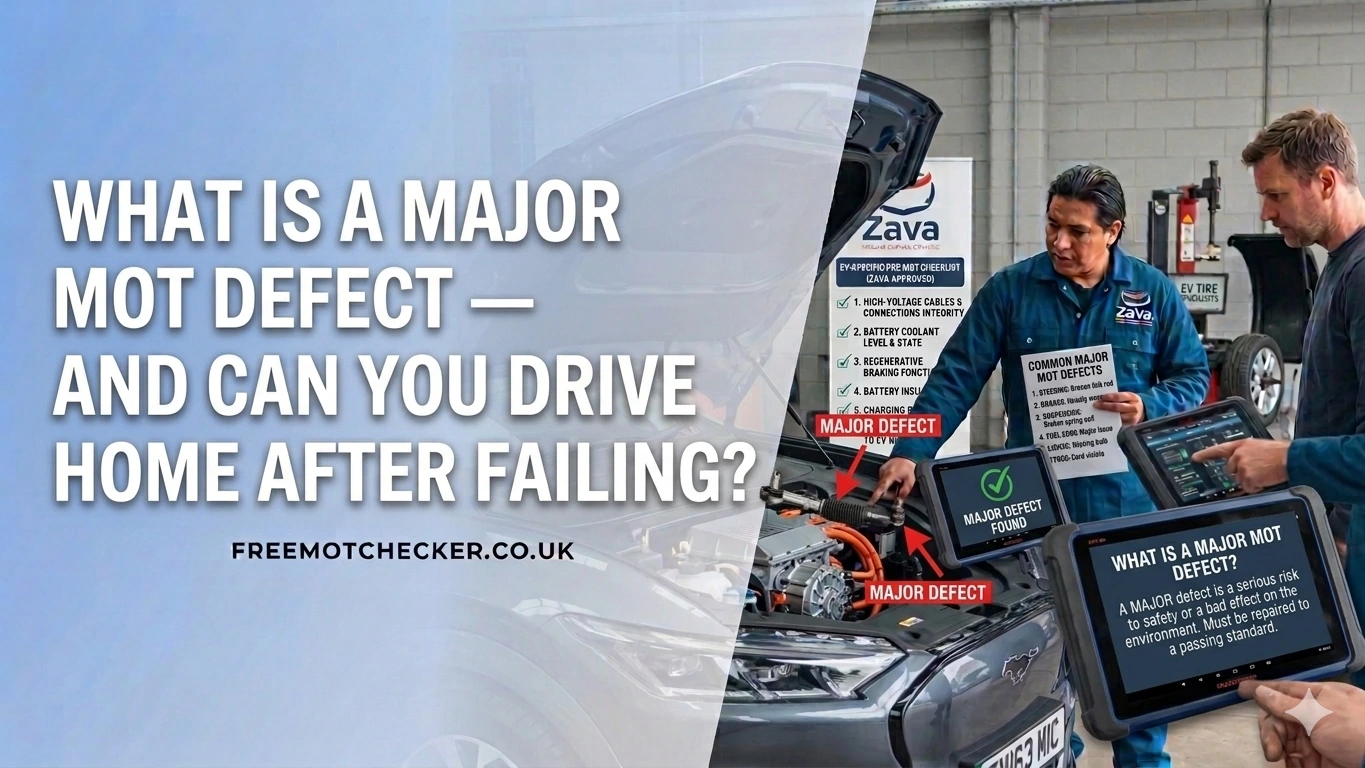
A major MOT defect means your car has failed its test. It is a fault serious enough to compromise safety, harm other road users, or damage the environment — but it stops short of an immediate danger on the road. Whether you can legally drive the car away depends on one critical question: has your previous MOT certificate expired yet?
This guide explains exactly what a major defect is, how it differs from a dangerous defect and a minor one, and the precise rules on driving after a major defect failure.
The Four MOT Outcome Categories — Where Major Defects Sit
When a tester assesses your vehicle, every fault is assigned to one of four categories. Understanding where major defects sit in that hierarchy is the key to knowing your options.
| Category | Causes failure? | Can you drive away? |
|---|---|---|
| Dangerous | Yes | No — under any circumstances |
| Major | Yes | Only if previous MOT is still valid and car is roadworthy |
| Minor | No | Yes — car passes |
| Advisory | No | Yes — car passes |
A major defect is a confirmed fault — not a borderline observation. The tester has determined that the component does not meet the minimum DVSA standard, and the failure is recorded instantly in the national MOT database.
For more on advisory notes and minor defects — the categories that do not cause failure — see our guide: What do MOT advisory notes mean — and do you have to fix them?
What Counts as a Major Defect?
The DVSA defines a major defect as a fault that could endanger road users, adversely affect the vehicle’s safety, or have a negative impact on the environment — but that does not represent an immediate risk in the same way a dangerous defect does.
In practical terms, major defects include faults where a component is clearly outside the legal standard but the vehicle retains some functional capacity. Examples include:
Brakes
- Brake pads worn below the minimum legal thickness
- Significant imbalance in braking between left and right wheels
- Brake fluid heavily contaminated or below minimum level
Tyres
- Tread depth below the legal minimum of 1.6mm on any tyre
- A visible cut or bulge in the tyre sidewall
- A tyre with exposed cords or structural damage
Lights
- A headlight not functioning at all (a single bulb out may be minor; complete loss of a beam is major)
- Brake lights that do not work
- Indicators that fail to function
Steering
- Excessive play in the steering column beyond legal limits
- Worn steering rack components causing unsafe handling
Suspension
- A shock absorber that has failed completely
- A ball joint with excessive play beyond DVSA thresholds
Emissions
- Exhaust emissions exceeding legal limits
- Visible heavy smoke during testing
Bodywork and structure
- A door that cannot be properly secured
- Structural corrosion in load-bearing areas of the chassis or floor pan
The key distinction from a dangerous defect is degree. A major defect is a confirmed failure — the car should not be used normally — but the DVSA does not classify it as posing an immediate danger to life.
What Is the Difference Between a Major and a Dangerous Defect?
A dangerous defect is the most severe classification. It means the DVSA considers the fault to present a direct and immediate risk to the driver, passengers, or other road users. Examples include complete brake failure, tyres with exposed cords under heavy load, or a steering fault so severe the vehicle cannot be controlled safely.
If your car has a dangerous defect, you must not drive it under any circumstances — even to a garage around the corner, even with the hazard lights on, even if your previous MOT certificate is still technically valid. The only legal option is to have the vehicle recovered or repaired on-site before it moves under its own power.
According to the GOV.UK guidelines, driving a vehicle with a dangerous defect can result in:
- A fine of up to £2,500
- Three penalty points on your licence
- A potential driving ban
A major defect is serious but does not meet this threshold of immediate danger. The nuance — and the part that confuses most drivers — is explained in the next section.
Can You Drive Home After a Major MOT Failure?
This is the question most drivers ask — and the honest answer is: it depends on whether your previous MOT certificate is still valid.
Scenario 1 — Your previous MOT has already expired
If your old certificate ran out before or on the day of this test, your car has no valid MOT. You cannot drive it on a public road except to travel directly to a pre-booked repair appointment or a pre-booked retest. You must be able to show proof of that booking if stopped by police.
There is no grace period. See our guide MOT grace period UK — is there one? What the law actually says for the full rules on this.
Scenario 2 — Your previous MOT is still valid
If you booked your MOT early and the previous certificate has not yet expired, a major defect failure does not automatically stop you driving the car. The existing certificate remains in force until its expiry date — the new failed test does not cancel it.
However, there is a critical condition: the car must still meet the minimum standards of roadworthiness. This means:
- All lights must be working
- Brakes must be functional
- Tyres must have at least 1.6mm of tread and be free from visible damage
- The vehicle must be controllable and safe to drive
If the major defect undermines any of these conditions — even while the old certificate is still technically valid — driving the car is still illegal. A car with a brake imbalance bad enough to fail the MOT is not necessarily safe to drive home, even with a certificate that does not expire until next month.
The practical test the DVSA applies is not “does a certificate exist?” but “is the vehicle roadworthy?” A valid certificate gives you no legal protection if the car is demonstrably unroadworthy.
The safest approach
Talk to the tester. Ask directly: “Is it safe to drive this home?” A qualified DVSA-approved tester will give you an honest assessment of whether the major defect actually makes the vehicle unsafe to move, or whether it is a technical failure that the car can still be driven with carefully for a short distance to a repair.
If there is any doubt, arrange a recovery rather than risk the journey.
What Happens After a Major MOT Failure?
When your car fails on a major defect, you will receive a VT30 certificate — the official Refusal of an MOT Test Certificate. This document lists every defect by category and code. Keep it. You will need it for the retest, and if you wish to appeal the result, you must submit the appeal before making any repairs.
Your next steps:
1. Get the repairs done Have the major defects repaired by a qualified mechanic. Keep all receipts and repair documentation — these may be needed for insurance purposes and for the partial retest.
2. Book a retest You have two options. If you return to the same garage that carried out the original test and have the repairs done within 10 working days, you are entitled to a partial retest at a reduced fee — only the failed items are re-examined. If you go elsewhere for repairs or wait longer than 10 working days, a full new MOT test applies.
For full details on retest rules, fees, and timescales, see our guide: MOT retest rules — free retest conditions, fees and time limits
3. Check your MOT history after the retest Once your car passes the retest, you can verify your new certificate immediately using our free MOT checker — enter your registration number to confirm the new expiry date is showing correctly in the DVSA database.
How Much Does Repairing a Major Defect Typically Cost?
Costs vary enormously depending on what failed. As a rough guide based on common major defects:
| Common major defect | Typical repair cost |
|---|---|
| Front brake pads (both sides) | £80 — £160 |
| Rear brake pads (both sides) | £70 — £140 |
| Single tyre replacement | £60 — £200 depending on size and brand |
| Headlight bulb replacement | £15 — £60 |
| Shock absorber (one corner) | £100 — £250 |
| Exhaust section repair/replacement | £80 — £300 |
For the full breakdown of MOT test fees and what to expect to pay, see our guide: How much does an MOT cost in the UK?
Can You Appeal a Major Defect Decision?
Yes. If you believe the tester incorrectly classified a fault as a major defect, you can appeal to the DVSA. You must submit the appeal before making any repairs — once the vehicle has been altered, the DVSA cannot assess the original condition.
To appeal, complete form VT17 on GOV.UK within 14 working days of the failed test. A DVSA vehicle examiner will contact you within five working days to discuss the next steps. If the appeal succeeds and the defect is downgraded, your vehicle may be issued a pass certificate without further repair.
Appeals are relatively rare and most are not upheld — but they are a genuine right if you believe your vehicle was failed incorrectly.
How to Avoid Major Defects at Your Next MOT
The most effective thing you can do is address advisory notes from your previous MOT before they escalate. Advisories are early warnings of components approaching the failure threshold — ignored long enough, they become the major defects that fail your next test.
You can view every advisory your vehicle has ever received using our free MOT history checker. If you have recently bought a used car, our car history check shows the full test record including recurring advisories across previous owners.
For a complete pre-MOT preparation checklist, see: How to prepare your car for an MOT
Frequently Asked Questions
Can I drive to work after a major MOT failure? Only if your previous MOT certificate is still valid and the car genuinely meets the minimum roadworthiness standards — functional lights, brakes, and tyres with at least 1.6mm of tread. Even then, you are taking a legal and safety risk. It is strongly advised to complete only essential journeys — specifically to a repair garage — until the defects are fixed.
Does a major defect invalidate my car insurance? Your insurance policy does not automatically lapse after an MOT failure. However, if you drive a vehicle with known major defects and are involved in an accident, your insurer may argue that you failed to maintain the vehicle in a roadworthy condition and could reduce or reject your claim.
How do I know if a defect is major or dangerous? Both categories appear on your VT30 certificate with clear labels. The tester is also required to explain the distinction to you verbally. If you are uncertain, ask directly — and ask whether the tester considers the car safe to drive at all.
What if both major and dangerous defects are listed on my VT30? The dangerous defect classification takes priority. You must not drive the vehicle regardless of the major defect rules. The car must be recovered or repaired before it can be moved on a public road.
Will the same defect fail me again at the retest? A partial retest only re-checks the items that failed. If your repairs are complete and the defect is properly fixed, the retest should pass those items. The tester will not look for new defects during a partial retest — unless something directly related to the repair is clearly unsafe.
What happens if I fail the retest as well? If you fail the retest, the process starts again — you will receive a new VT30 and need to arrange further repairs. For a full walkthrough of what happens at this stage, see our guide: What to do if you fail the MOT retest
Last reviewed: April 2026. Based on DVSA MOT defect classification guidance and current UK motoring law.
Written by Haseeb — Founder, Free MOT Checker. All guides are reviewed against current DVSA standards and UK motoring law.