Around one in five cars fails its MOT in the UK every year. A significant proportion of those failures are for faults the driver could have spotted and fixed themselves in under an hour, often for a few pounds.
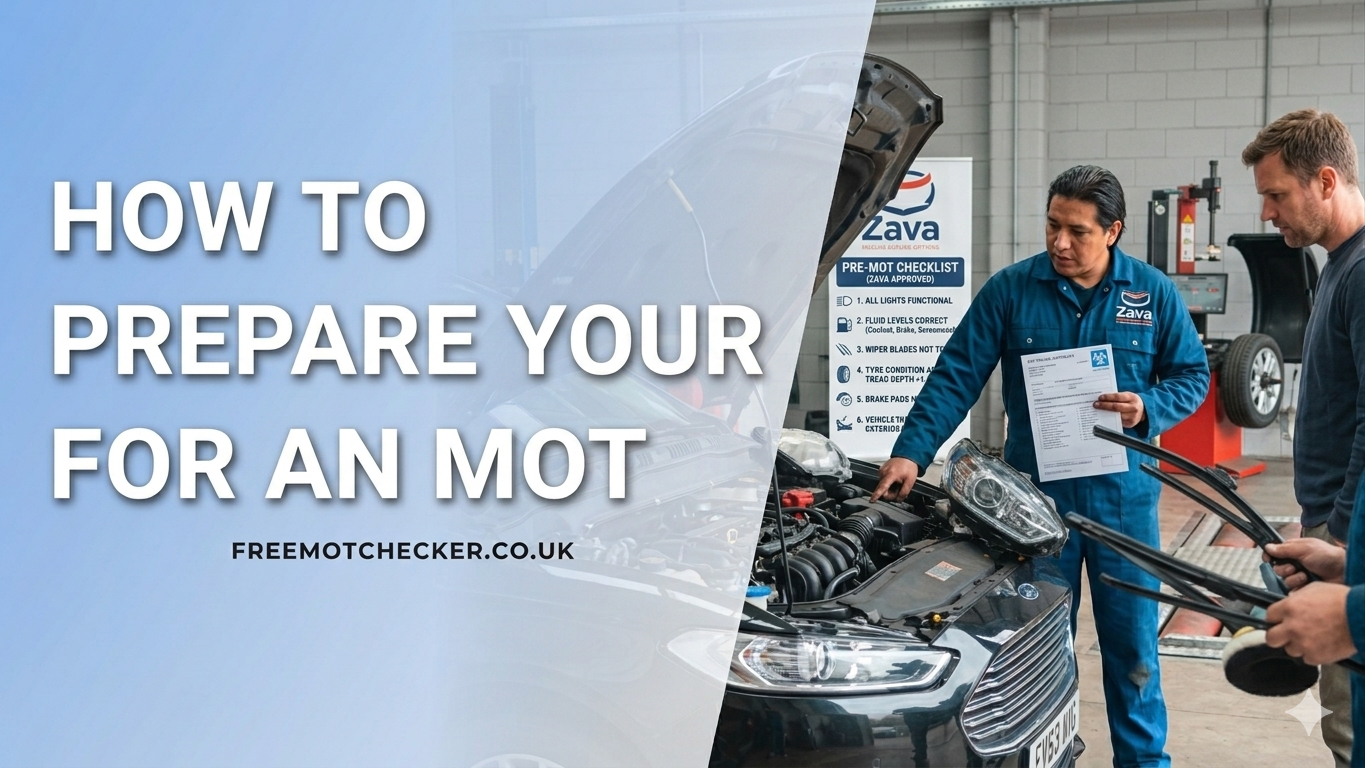
This guide gives you a systematic pre-check routine to work through before your test — the same areas MOT examiners inspect first. None of it requires mechanical expertise, just a few minutes and a willingness to look.
Before you start, check your car’s full MOT history to review any advisory notes from last year’s test. Those advisories are the single strongest predictor of what your car might fail on this year. The DVSA’s own data shows that the most common MOT failures are almost entirely preventable with basic pre-test checks.
1. Lights and Indicators
Lighting faults are consistently the most common reason for MOT failure in the UK, according to DVSA failure data. A single non-functioning bulb is enough to fail the test.
Walk around the car and check every light: headlights on main beam and dipped, rear lights, brake lights, both indicators front and rear, hazard lights, number plate light, and reversing light. Ask someone to sit in the car and operate the pedals and switches while you check from outside, or back up to a reflective surface to see the rear lights yourself.
Replacement bulbs for most vehicles cost between £2 and £8 and take minutes to fit. If any light housing is cracked or water-damaged, the examiner may also flag this, so inspect the casings as well as the bulbs.
Daytime running lights (DRLs) are now checked on vehicles registered after March 2018. Make sure these are functioning if your car has them.
2. Tyres
Tyre faults are the second most common reason for MOT failure. The minimum legal tread depth in the UK is 1.6mm across the central three-quarters of the tread, around the entire circumference of the tyre.
To check tread depth without a gauge, use the 20p test. Insert a 20p coin into the tread groove. If the outer band of the coin — the raised rim — is hidden when inserted, your tread is above the legal minimum. If you can see the outer band clearly, your tyres are likely below the limit and will fail.
Check all four tyres, including the inner edges, which wear faster on many front-wheel-drive cars. Also inspect the sidewalls for cuts, bulges, or any visible damage. A tyre with a bulge in the sidewall is an immediate MOT failure regardless of tread depth.
Check tyre pressure while you are there. The DVSA introduced tyre pressure as a potential failure point in recent updates — significantly underinflated tyres can now contribute to a fail. Your correct pressures are listed on a sticker inside the driver’s door frame or in your owner’s handbook.
3. Brakes
You do not need to remove a wheel to get a sense of your brakes before the test. Several signs of brake problems are noticeable during normal driving.
Listen for squealing, grinding, or pulsing when you brake. Squealing often indicates worn brake pads that have reached their wear indicator. Grinding usually means the pads have worn through entirely and metal is contacting the disc — this is a serious issue that will fail the MOT and can cause brake failure if left further.
Test the handbrake on a slope if possible. It should hold the car securely without being pulled more than six to eight clicks. If it requires excessive force or the car rolls, the cable or mechanism may need adjustment.
If you notice the car pulling to one side under braking, this suggests uneven brake performance — another MOT failure point.
For a full explanation of what the MOT examiner checks on your braking system, see our guide to what gets checked on an MOT.
4. Windscreen and Wipers
The MOT examiner inspects the windscreen for cracks or chips in specific zones. A crack or chip larger than 10mm anywhere in the area directly in front of the driver — roughly a 290mm zone in the driver’s line of sight — will fail. Any damage larger than 40mm anywhere else on the windscreen swept by the wipers is also a failure.
Small chips outside the driver’s vision zone that are smaller than 40mm are usually advisories rather than failures, but they should still be repaired. Most windscreen chip repairs are covered under comprehensive car insurance with no excess, and they can be done by a mobile technician at your home or workplace in about 30 minutes. Autoglass and National Windscreens both offer free-to-you chip repairs under insurance.
Test your wipers on the windscreen with washer fluid. They should clear the screen effectively without streaking, skipping, or leaving large uncleared sections. Replacement wiper blades typically cost £10 to £20 for a pair and clip on without tools.
Check that your windscreen washer reservoir is topped up. Running dry during the test is noted, and low fluid is sometimes flagged as an advisory.
5. Horn
This is one of the quickest checks on the list. Sound your horn briefly. It must work and be audible. If it does not work, does not make a sound, or sounds weak and intermittent, have it looked at. Horn failures are rare but they are a straightforward MOT fail when they occur.
6. Mirrors
Your car must have at least two working mirrors providing an adequate rear view. All mirror housings must be secure, and the glass must be intact. A cracked or missing mirror is an MOT failure. Check your interior mirror and both wing mirrors are firmly attached and undamaged.
7. Seatbelts
Test every seatbelt in the car — driver, passenger, and all rear seats. Each one should pull out smoothly, click securely into its buckle, retract cleanly, and hold under a sudden sharp pull. The MOT examiner will check that the webbing is not frayed, cut, or visibly degraded. Seatbelt faults that are not caught early can also render your insurance invalid in the event of an accident.
8. Fluid Levels
Low or contaminated fluids will not automatically fail your MOT in most cases, but some can trigger related failures. Low brake fluid, for example, may indicate worn brake pads and can contribute to a braking system failure. The DVSA now checks brake fluid condition as part of the standard test.
Check the following under the bonnet with the engine cold. Engine oil should sit between the minimum and maximum marks on the dipstick. Coolant in the reservoir should be between the minimum and maximum markers. Brake fluid in the reservoir should be above the minimum line. Windscreen washer fluid should be topped up.
9. Number Plates
Your number plates must be secure, clean, and readable. They must be the correct format for the vehicle’s registration year — the style, font, and character spacing are regulated. Plates with decorative borders, flags, or non-standard fonts that obscure the characters can fail the test.
Make sure both plates are firmly attached. A loose or partially detached plate is a failure point. Also ensure the registration number is correct and matches your vehicle’s registration certificate (V5C).
10. Engine Warning Lights
If your engine management light (EML) or any other warning light related to the emission control system is illuminated when the test starts, it will likely result in a failure. Many drivers ignore warning lights for weeks without realising they will cause an MOT failure.
Check your dashboard with the engine running. If any warning light related to the engine, emissions, or safety systems is on, have the fault diagnosed with a diagnostic reader before your test. Many motor factors and some Halfords branches will read fault codes for free.
The Day Before Your Test: Final Checks
The evening before your test, run through this quick summary checklist.
All exterior lights working — including number plate light. Tyre tread above 1.6mm with no visible sidewall damage. Tyre pressures correct for your vehicle. No significant windscreen damage in the driver’s zone. Wipers clearing the screen cleanly. Washer fluid reservoir topped up. No warning lights on the dashboard. Horn sounding when pressed. Seatbelts locking and retracting properly. Mirrors intact and secure. Number plates clean, secure, and correctly formatted.
If everything checks out, you have addressed the most common failure points. For a complete picture of your car’s recent advisories and any previous failures, check your full MOT history before the test.
What Happens If Your Car Still Fails?
Even with thorough preparation, cars sometimes fail on faults that are not visible to the driver. If your car does fail, ask the garage for the complete VT30 failure certificate, which lists every reason for the failure. For a full explanation of your options after a fail, including retest rules and whether you can drive home, see our guide to what happens after an MOT fail.
Frequently Asked Questions
What are the most common reasons for MOT failure in the UK? According to DVSA data, the most common reasons are lighting faults (particularly bulbs), tyre condition and tread depth, and brake defects. These three categories account for the majority of all MOT failures and are all checkable before the test.
How long does a pre-MOT check take? Working through all the checks above systematically takes around 30 to 45 minutes. You do not need tools for most of them.
Should I warm up my car before an MOT? Yes. Drive the car normally to the test centre rather than starting it cold just before the test. A warm engine performs better in the emissions test, and the brakes bed in during the drive.
Can I fail an MOT for a dirty car? Not technically, but an extremely dirty car can prevent the examiner from seeing things clearly, and some heavily soiled number plates have caused issues. Arrive with a reasonably clean exterior and a clear windscreen.
What happens to the old MOT certificate once the new one is issued? Nothing — you keep it. MOT certificates have no monetary value once they expire, but they form part of your service history record and can be useful when selling the car. All your test history is also stored permanently in the DVSA database and can be accessed at any time using your registration number.
Do I need to take my logbook to the MOT? No. The MOT test requires only the vehicle. The examiner does not need to see your V5C registration document, your insurance certificate, or your driving licence.
Sources: DVSA MOT failure data, GOV.UK MOT testing guidance, Road Traffic Act 1988, Consumer Rights Act 2015.